REVIEW · OSAKA
Nara Early Morning Tour (Osaka Departure Option)
Book on Viator →Operated by GuideMe Japan · Bookable on Viator
Want Nara without the afternoon chaos? This early morning plan gets you to the big sights before the crowd surge, and the small group size (up to 8) keeps things moving at a human pace with room to ask questions.
I like that the tour is built for actual sightseeing time, not long waits and detours. You’ll cover Kofuku-ji, Kasuga Grand Shrine, Nara Park, and Todai-ji in about 4.5 hours, with most of the experience handled through guided stops and a mobile ticket.
The trade-off is effort: you’ll walk around 10,000 steps, and once you finish at Kintetsu Nara Station, you’re on your own for the trip back. Also, do not run late.
In This Review
- Key highlights at a glance
- Why the early Nara start from Osaka is the smart move
- Meeting in Umeda: getting lined up without stress
- Kofuku-ji Temple: pagoda views before the day fills in
- Kasuga Grand Shrine and its lanterns (about 3,000 of them)
- Nara Park deer: sacred symbolism and real-life close encounters
- Todai-ji Temple and the Great Buddha: the scale hits fast
- Pace, walking 10,000 steps, and what “moderate fitness” really means
- Price and value: what you actually get for $87.96
- Using the tour to build the rest of your day in Nara (or beyond)
- Should you book this Nara early morning tour from Osaka?
- FAQ
- FAQ
- How long is the Nara Early Morning Tour from Osaka?
- How many people are in the group?
- What’s the walking distance like?
- Where does the tour start?
- Where does the tour end?
- Is the tour from Osaka to Nara included in the price?
- Are temple and shrine admissions included?
- Is the tour English-speaking?
- Is there a private vehicle for the group?
- What if I’m late or miss part of the tour?
Key highlights at a glance
- Early timing for better photos: hit Kofuku-ji and Todai-ji before the afternoon rush.
- Small group energy: up to 8 people means a calmer pace and more attention from the guide.
- Kasuga’s lantern world: about 3,000 stone and bronze lanterns, plus built-in context for what you’re seeing.
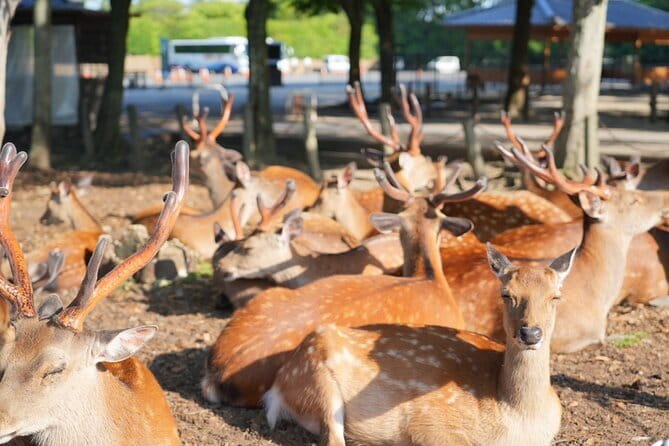
- Deer-at-Nara Park factor: thousands of sacred deer, best experienced before the day gets loud.
- Half-day payoff: ends before noon at Kintetsu Nara Station so you can keep going elsewhere.
Why the early Nara start from Osaka is the smart move
Nara gets crowded, fast. If you’ve ever tried to photograph a major temple while people shuffle into your frame, you already know the problem. This tour solves it by pushing the “big Nara moments” into the early hours, when the light is nicer and the crowds are still warming up.
That early start also changes how the day feels. Instead of rushing through the highlights in a stampede, you get a slower, clearer experience. You walk between stops, you get explanations as you go, and you’re not constantly fighting for space around the main buildings and viewpoints.
Another quiet win: it ends before noon. That matters because Nara is a great half-day place, but Osaka and Kyoto are also close enough to turn this into a full itinerary. When you’re done at Kintetsu Nara Station in the morning, you still have the rest of the day to explore more in Nara or head back toward Osaka and beyond.
You can also read our reviews of more tours and experiences in Osaka

Meeting in Umeda: getting lined up without stress
The tour begins at the Osaka Tourist Information Center, inside the JR Osaka Station area (Umeda), right at the Central Concourse. It’s a good meeting point because you’re already in a major transit hub, and you can usually orient yourself quickly without guesswork.
A couple practical notes shape your day:
- Public transportation only: there’s no private vehicle. The group rides regular transit as you move between Osaka and Nara and then between sites once you’re there.
- Mobile ticket: you won’t be hunting for paper vouchers. Have your ticket ready on your phone.
- Small group cap: up to 8 people means the guide can keep track of everyone more easily, which helps when you’re switching trains or buses.
Also, the tour explicitly warns about timing. Don’t treat the meeting time like a suggestion. If you show up late, refunds don’t apply. If you’re traveling from anywhere besides the Osaka station area, I’d give yourself a little extra cushion.
Kofuku-ji Temple: pagoda views before the day fills in
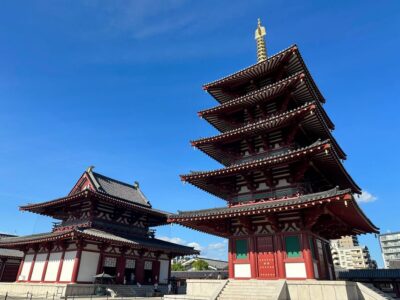
Kofuku-ji Temple is one of Nara’s key stops, tied to the early era when the capital was established in 710. That date matters because it’s not just a pretty temple stop. It’s part of how Nara became important in Japan’s religious and political life.
This is also where the tour’s early strategy really pays off. The highlight is the famous five-storied pagoda, known as the second tallest wooden pagoda in Japan (just seven meters shorter than the tallest). In the early hours, you’re more likely to enjoy the space around it instead of getting swallowed by the crowd.
What I’d watch for during your time there:
- The scale of the pagoda against the surroundings, especially if you’re used to modern city structures.
- The way the temple grounds feel when the tour pace stays calm. You’re not sprinting between photo spots; you’re getting time to look.
Admission at Kofuku-ji is free on this tour. You’re there for about an hour, which is enough time to absorb the setting, take pictures, and then keep your energy for the next locations.
Kasuga Grand Shrine and its lanterns (about 3,000 of them)
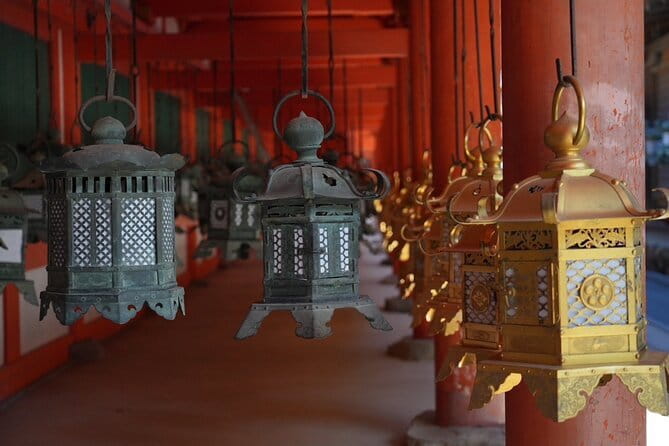
Kasuga Grand Shrine is the lantern stop, and it’s not a small-detail kind of place. It’s famous for lanterns donated by worshippers over generations.
You’ll see roughly 3,000 stone and bronze lanterns in and around the shrine area. That number helps you understand why this place feels different from a single landmark you glance at and move on. It’s more like a long visual field: lanterns keep appearing as your eyes move, and the whole shrine becomes a kind of living display.
This stop also comes with admission included, so you’re not scrambling for extra payments while you’re standing in the middle of it.
A practical tip for enjoying it: slow down your walking. Lantern-lined spaces can be photographed well, but rushing usually leads to blocked angles and missed details. If you want your photos to look intentional, give yourself a minute to find one clean viewpoint, then start exploring from there.
Nara Park deer: sacred symbolism and real-life close encounters
Nara Park is famous for deer, and this tour gives you a focused hour there. You’re in the right spot for the classic scene: thousands of wild deer roaming through the park.
The tour framing also helps you understand why the deer matter culturally. They’re considered sacred, tied to a story connected to Kasuga Shrine. The idea is that one of the four gods in Kasuga Shrine rode the deer to Nara, which is why the animals became part of the spiritual story of the area.
How to enjoy it in a way that stays respectful and comfortable:
- Keep some distance when you can, especially if you’re holding food or a drink.
- Don’t assume every deer interaction is the same. Some will ignore you; others will be curious.
- Think of the deer as a moving foreground. Your best photos often come from waiting for the deer to turn or step into the open rather than chasing the perfect shot.
Because this is still early in the day, the park typically feels more manageable than later. You’re less likely to get trapped in a long loop of people trying to photograph the same spot.
This stop is free, and it’s roughly one hour, which is just enough time to enjoy the atmosphere without turning the park into your entire day.



Todai-ji Temple and the Great Buddha: the scale hits fast

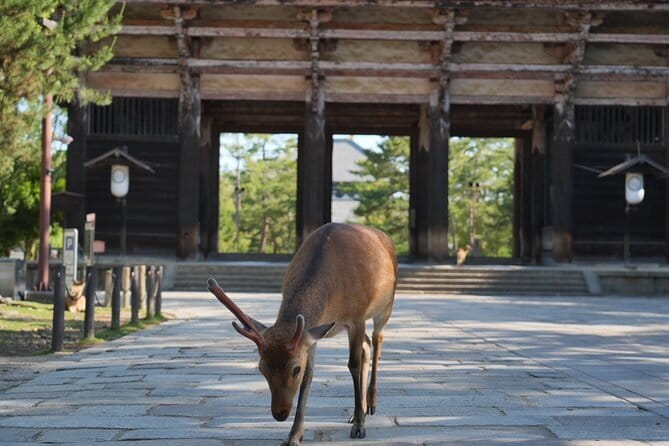
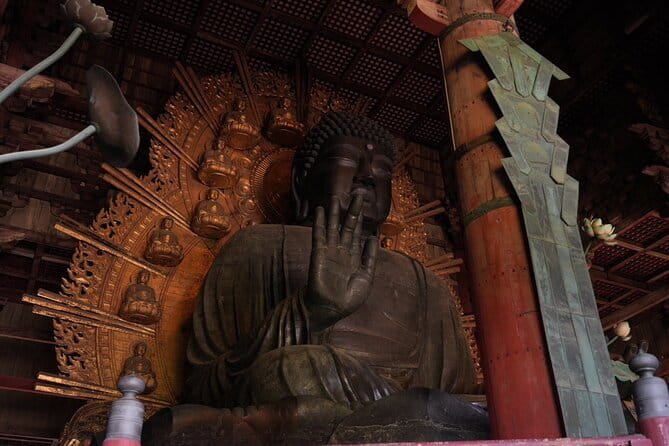
Todai-ji Temple is the heavyweight. This is where you come for the Great Buddha statue, described as the biggest Buddha statue in Japan. Once you see it, you’ll understand why this temple draws serious attention.
The tour also points out something important about the building’s past: until recently, the man hall was the world’s largest wooden building. That detail gives you a different way to look at the architecture. You’re not only seeing today’s temple structure. You’re also imagining how enormous it must have felt when it was at its peak of size and ambition.
Todai-ji is where you should be ready to pay a bit extra. Admission for Todai-ji Temple is listed as not included, with an 800 yen fee. Budget for that so you’re not caught by surprise once you’re already there.
For your one-hour stop, I’d plan to do two things:
- Spend a few minutes orienting yourself to the main hall and the statue viewpoint.
- Then use the remaining time to walk around and notice how the space feels from different angles.
Early morning helps here too. When you get to the Great Buddha before the biggest afternoon wave, the experience feels less like a line and more like a moment.
Pace, walking 10,000 steps, and what “moderate fitness” really means

This is a walking tour with public transit in the mix. The estimate is around 10,000 steps, and it’s meant for people with moderate fitness.
That doesn’t mean you need to be an athlete. It does mean you should plan for:
- Time on your feet between temple areas and shrine pathways.
- Uneven surfaces in older temple grounds.
- Regular walking plus transit transitions.
The payoff for that effort is a tour that ends before noon. If you want to see the key Nara sights in one clean block and then still have time for the rest of your day, this format works.
Also, the group size matters. Up to 8 people gives the guide room to keep track and adjust the pace. In earlier tours, guides named Koh, Lin, and Soichiro have been praised for being helpful and for adding depth to what you’re seeing. You’ll get English explanations, and in practice that can help you move through big temples with less confusion.
One more practical point: because you’re using public transportation and there’s no private vehicle, the day depends on normal transit timing. Try not to build your next appointment too tightly after the tour ends.
Price and value: what you actually get for $87.96
At $87.96 per person, you’re paying for more than just access to a few famous names.
Here’s where the value shows up:
- English-speaking guide for the full route, not just a quick intro.
- Transportation fee from Osaka to Nara Station is included in the tour price.
- Kasuga Grand Shrine admission is included.
- Kofuku-ji Temple and Nara Park are free stops on this route.
The one clear extra cost to plan for is Todai-ji Temple, listed as an 800 yen admission fee not included in the base price.
So how do you judge whether it’s worth it for you? I’d say it’s strong value if you:
- Want the early crowd advantage without trying to guess bus and train timing yourself.
- Prefer guided context so you’re not just taking photos but also understanding what you’re looking at.
- Like the idea of a half-day itinerary that ends with time remaining.
If you’re the type who enjoys fully independent travel and you’re confident sorting trains and navigating temple grounds on your own, you might do it cheaper. But you’d likely spend time figuring out logistics instead of using that time to see and learn.
Using the tour to build the rest of your day in Nara (or beyond)
The tour concludes at Kintetsu Nara Station. That location is helpful because it gives you a straightforward anchor point to continue your day.
Because the tour ends before noon, you have options:
- Keep exploring more of Nara at a relaxed pace.
- Plan a second Nara walk-through while you’re already familiar with the area.
- Or use the morning momentum to turn this into a bigger day trip back toward Osaka or onward to Kyoto.
This is one of those itineraries that works best when you treat it like the first chapter of your day. You’re not stuck committing the whole day to Nara because you’re already done with the big four sights by late morning.
Should you book this Nara early morning tour from Osaka?
Book it if you want the smart version of Nara: big temples, deer, and lanterns, timed to dodge the worst crowds. It’s also a good fit if you like small-group pacing and would rather spend your energy looking and learning than figuring out logistics.
Skip it or reconsider if you:
- Want a car-free tour but aren’t comfortable with a long walk estimate around 10,000 steps.
- Need a flexible end time beyond before-noon. This tour ends before noon, and your return travel is on you.
If your goal is to see the classic Nara highlights in one morning block and still have the rest of the day to roam, this is a solid, practical choice.
FAQ
FAQ
How long is the Nara Early Morning Tour from Osaka?
It’s about 4 hours 30 minutes (approx.).
How many people are in the group?
The tour has a maximum of 8 travelers.
What’s the walking distance like?
You’ll walk about 10,000 steps.
Where does the tour start?
The meeting point is Osaka Tourist Information Center, located in Osaka Station’s Central Concourse area in Umeda.
Where does the tour end?
The tour concludes at Kintetsu Nara Station.
Is the tour from Osaka to Nara included in the price?
Yes, the fee from Osaka to Nara Station is included. The fee on the way back is not included.
Are temple and shrine admissions included?
Kofuku-ji Temple is free, and Nara Park is free on this route. Kasuga Grand Shrine admission is included. Todai-ji Temple has an 800 yen admission fee that is not included.
Is the tour English-speaking?
Yes, you’ll have an English-speaking guide.
Is there a private vehicle for the group?
No. It’s a walking tour that uses public transportation, with no private vehicle.
What if I’m late or miss part of the tour?
The tour notes that if you are late, you will not be granted a refund. Please do not be late.