REVIEW · OSAKA
Samurai Calligraphy:Final brushstrokes of a lifetime before a War
Book on Viator →Operated by SAMURAI HONOR · Bookable on Viator
A single character can feel like a farewell. In Osaka, this samurai calligraphy session turns brushwork into a personal goodbye moment, built around shodo technique and a symbolic last character. I like that you start by making a thoughtful choice, then you practice the strokes methodically before you go big with a huge brush on a 150cm x 150cm sheet. One thing to consider: the theme is resignation before going to war in the Warring States period, so the mood can be intense if you prefer lighter cultural activities.
I also enjoyed how personal it felt with guidance from teacher Kaori, who helps shape your character choice and performance. The smaller group size (up to 8) matters here, because you get real coaching instead of just watching from the sidelines. If you want more than one finished piece or a longer practice session, this is still a short class, focused on producing that single powerful character.
The experience runs about 90 minutes total, and it ends back at the meeting point, so it’s easy to plug into an Osaka day. You’ll dress in traditional samurai style (with hakama and kimono elements, not a full kimono set) and you’ll have a professional photographer involved.
In This Review
- Key Highlights You Should Know
- Why Samurai Calligraphy in Osaka Feels Unusual
- The 60 Minutes of Shodo Basics (Where Control Gets Built)
- Samurai Calligraphy in 30 Minutes: One Character at Giant Scale
- Outfit, Photographer, and Optional Extras You Should Plan For
- The Teacher Experience: What Kaori’s Coaching Adds
- Price and Value: Why $64.38 Can Make Sense Here
- Getting There and Showing Up Ready
- Who Should Book This Samurai Calligraphy Session
- Should You Book Samurai Calligraphy: Final Brushstrokes Before a War?
- FAQ
- How long is the Samurai Calligraphy experience in Osaka?
- What exactly do I do during the class?
- What’s included in the price?
- Is there help if I don’t speak Japanese?
- How many people are in the group?
- Where is the meeting point?
- Is there a cancellation option for a full refund?
Key Highlights You Should Know
- Pick your own resignation kanji and practice stroke order based on what it means to you
- Learn basic shodo first, then apply it under pressure-free guidance
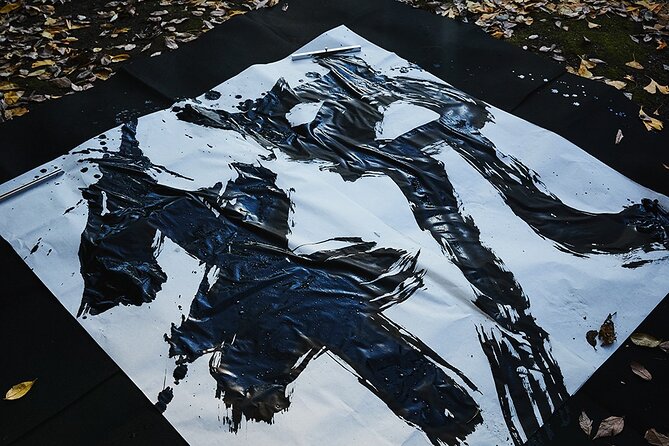
- Write one character at giant scale using an oversized brush more than five times larger
- 150cm x 150cm paper creates a dramatic, performative feeling you can’t replicate at home
- A personal touch from the teacher is part of the experience, including symbol selection tied to your choice
- English or Chinese assistant support helps you follow instructions clearly
Why Samurai Calligraphy in Osaka Feels Unusual
Most calligraphy classes teach how to hold a brush and make pretty lines. This one starts from a very specific idea: your last brushstrokes before death, like last words on earth. The prompt is called resignation, and it’s tied to the Warring States period, when life and death sat close together.
That framing changes how you pay attention. Instead of making art just to be admired, you treat your character like a message. You’ll decide on one kanji character for your resignation, then practice its strokes so you can write it with control when it counts. The concept also leans into Japanese ideas of beauty that aren’t about filling every corner: the beauty of the margins and the value of blank space. In plain terms, the empty paper matters as much as the ink.
There’s also a rhythmic performative element. The circle mark (the ◯) is written boldly to the beat of taiko drums, which turns a simple shape into something like timing practice for your hand and breath. If you like arts that have both meaning and technique, this is a strong match.
And because it’s capped at a small group size, you’re not just a spectator. You’re actively thinking, practicing, and then making one final character in a way that feels earned.
You can also read our reviews of more tours and experiences in Osaka.


The 60 Minutes of Shodo Basics (Where Control Gets Built)
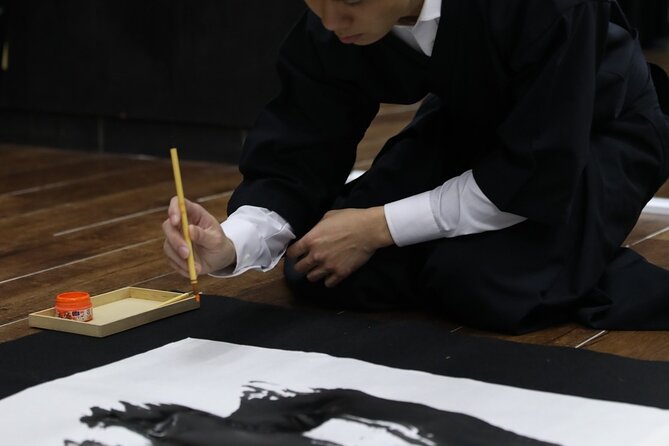
You’ll spend about 60 minutes on Japanese shodo, and the order of operations matters. The session doesn’t jump straight to the big brush. It starts with thinking and then moves into technique.
First, you’ll decide on the last character. The key point is that each kanji character has its own meaning, so you’re asked to reflect on your life and feelings when choosing. You’re not just picking something that looks cool; you’re choosing something that represents what you want to leave behind.
Next comes the practice part. You’ll work on basic brush strokes and the stroke order of your chosen kanji. That’s not a minor detail. Stroke order is what keeps calligraphy from becoming a random collection of marks. It trains your hand to understand the character structure before you scale up.
You’ll also practice how to handle the brush with intention. Even if you’ve never written kanji before, you’ll be taught what to watch: the thickness of the line, how the brush tip moves through the paper, and how to avoid making the strokes stiff or shaky.
If you like learning processes that make you feel calmer, this is close to that. You’re focused on one task and improving it step by step. One review described the class like meditation, and the pacing supports that: less rushing, more careful repetition.
Samurai Calligraphy in 30 Minutes: One Character at Giant Scale
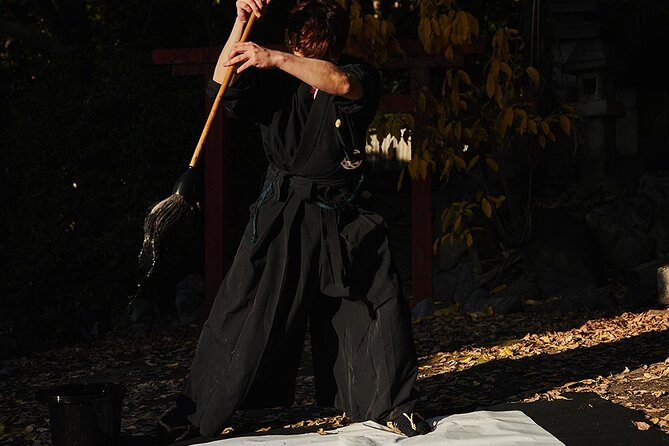
Then you move to the main event: Samurai Calligraphy for about 30 minutes. Here’s where the class goes from training to performance.
You’ll write one character for resignation. Before ink goes down, you’ll be prompted to reflect again and shape your character composition, design, and overall feel. In other words, you’re thinking about not just the kanji, but also how you want it to read as a final message.
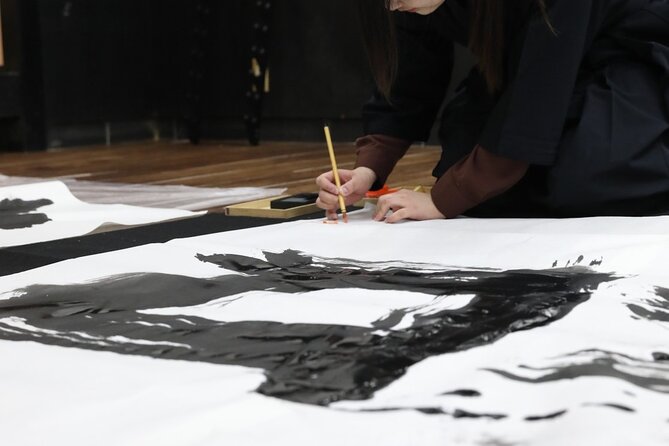
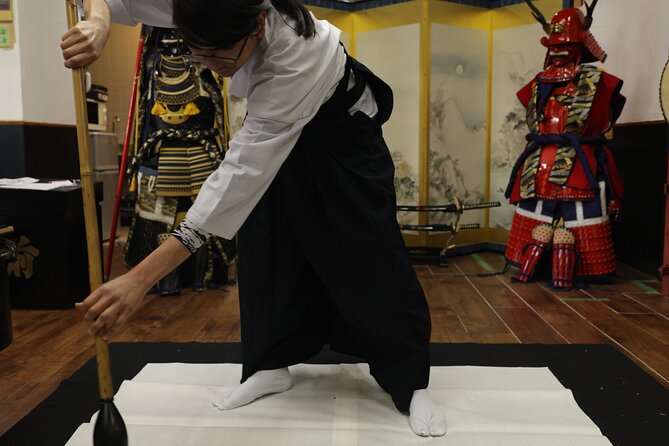
The class uses an oversized brush that’s more than five times larger than usual. That size changes everything. The movement becomes whole-body. Your shoulder and arm positioning matter more, and you have to let the brush travel smoothly instead of micro-correcting like you would with a regular pen.
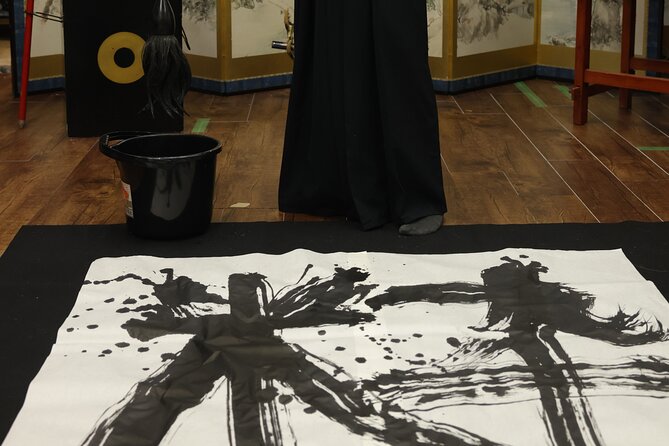
Your canvas is huge: a 150cm x 150cm sheet of paper. The paper size forces a different kind of confidence. You can’t cram it into a corner. You also get that balance between power and fragility the instructor is aiming for, because one character can feel both bold and delicate at the same time.
The process leans into that Japanese sense of beauty where the empty space is part of the final look. The class also specifically mentions writing the ◯ boldly to taiko drum timing. Even if you only do it once, you feel how rhythm helps your hand land cleanly.
If you’re expecting many finished pieces, adjust your expectations. This is about one big, finished character with meaning, not a production-line souvenir set. The payoff is that your final work has a stronger identity because it’s built on your choice and practice.
Outfit, Photographer, and Optional Extras You Should Plan For
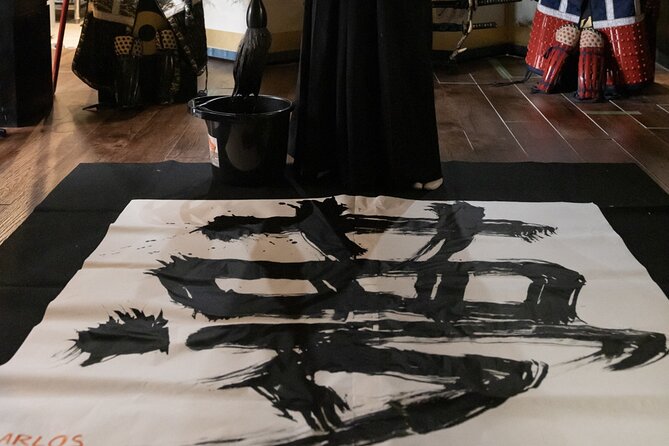
One of the easiest ways this class stands out is how it looks and feels. You’ll wear a samurai outfit, including hakama and kimono pieces (not a full kimono set). You should expect to dress a bit more formally than normal street clothes, and you’ll likely feel the moment become a small event.
A professional photographer is included. That’s a big value add, because it removes the hassle of finding someone to take photos while you’re in full costume mid-brushstroke. You can just focus on the brush and let the photos happen.
There are also paid add-ons mentioned for those who want extra media or styling:
- Movie shooting is available as a paid option (¥11,000 per person)
- Wagami (collected hair plus kanzashi) is also a paid option (¥3,300 per person)
Whether you do these is totally up to you. If you’re the type who likes a clean, simple souvenir, stick with the included photography. If you want a more cinematic experience, the paid video option might be worth it, especially if you know you’ll share your final character attempt.
Practical tip: wear comfortable clothes you don’t mind adjusting under the outfit. You’ll be moving your arms for big brush strokes, so you want to avoid anything that rides up or binds. Simple and comfortable is the safest approach.
The Teacher Experience: What Kaori’s Coaching Adds
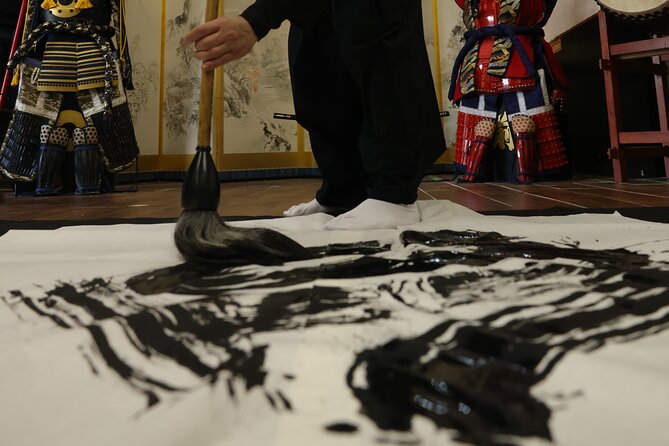
This class works because the instruction is active. One standout element from past sessions was the teacher’s involvement in the personal side: Kaori helped shape the experience, including writing participants’ names and selecting symbols that match what you chose.
That matters because calligraphy can feel intimidating if you’re left to translate meaning into technique by yourself. With a teacher guiding your character selection and stroke preparation, you’re more likely to end up with something you feel genuinely connected to.
You also get English or Chinese speaking assistant support. That doesn’t mean the whole class turns into a lecture, but it helps you follow the steps without guessing.
With a maximum group size of 8 travelers, you’re not competing for attention. You can ask questions and get corrections while your ink is still fresh in your mind.
If you want history and culture alongside the art, the class delivers that too. The prompts and the resignation framing give you a reason to understand what you’re writing, not just how you’re writing it.


Price and Value: Why $64.38 Can Make Sense Here
At $64.38 per person, this is not a massive budget item for Osaka. But the value isn’t just the class time.
You’re paying for a full package:
- shodo instruction and stroke practice
- Samurai calligraphy with the oversized brush experience
- shodo tools
- the samurai outfit elements (hakam and kimono pieces, not a full set)
- a professional photographer
- English or Chinese speaking assistant support
- and you get a mobile ticket
Also, the time is tight and efficient: about 90 minutes total. That matters in a city where you’re constantly deciding how to spend your limited hours. You get one main creative output, not a half-day commitment.
If you compare to other cultural workshops that might include only instruction, the photography and outfit support make this easier. You don’t need to solve the logistics of getting dressed and photographed at the same time. The oversized brush and giant paper are also the kind of experience that’s hard to recreate elsewhere, so the cost feels grounded in materials and skilled guidance.
One caveat: because it’s focused on one character, it’s best seen as a guided art performance with technique, not an open-ended art studio session.
Getting There and Showing Up Ready
The meeting point is in Joto Ward, Shiginonishi, Osaka:
- 536-0014 Osaka, Joto Ward, Shiginonishi, 2-chōme 3-19 エクセレンス高山
The activity ends back at the meeting point.
It’s described as near public transportation, which is what you want in Osaka. Plan to arrive a few minutes early so you can get settled before dressing and starting the shodo portion.
Because you’ll be using tools and writing on a large sheet of paper, you should treat the experience like a hands-on performance. Show up in comfortable clothes, keep your hands free of bulky items, and keep your phone use minimal once the class begins.
And if you’re thinking about cancellation timing, the policy is straightforward: free cancellation is available up to 24 hours before the experience start time for a full refund. That gives you some flexibility if your Osaka plan shifts.
Who Should Book This Samurai Calligraphy Session
Book it if you want:
- a meaningful art experience where the meaning of a kanji character matters
- real instruction on strokes and stroke order, not just free-form play
- a performative moment with an oversized brush and giant paper
- photos taken for you while you’re in costume
It’s also a great fit if you like calm concentration. The class structure can feel like a reset button: choose a character, practice carefully, then do one big final piece.
Consider skipping or changing expectations if:
- you prefer light, purely recreational souvenirs
- you’re uncomfortable with themes tied to death and war framing
- you want multiple finished artworks or long studio time
Should You Book Samurai Calligraphy: Final Brushstrokes Before a War?
Yes, if you’re the type who enjoys discipline in art and symbolism in culture. The best reason to book is the structure: thoughtful character choice, technique practice, then a single oversized character that turns your strokes into a real moment. The combination of shodo basics, the huge brush experience, and the included outfit plus photographer makes it feel like more than a standard workshop.
Skip it if you want lots of different pieces, or if the resignation theme doesn’t work for your mood. But if you’re open to a quiet, focused, meaningful class in Osaka, this is the kind of activity you’ll remember because you made one finished calligraphy character with intention.
FAQ
How long is the Samurai Calligraphy experience in Osaka?
The total experience is about 1 hour 30 minutes. It includes Japanese shodo for about 60 minutes and Samurai Calligraphy for about 30 minutes.
What exactly do I do during the class?
You choose a last character (kanji) for resignation, practice basic brush strokes and stroke order, and then write one character as your final piece using an oversized brush on a 150cm x 150cm sheet of paper.
What’s included in the price?
Included items are shodo tools, the samurai outfit elements (hakama and kimono pieces, not a full set of kimono), a professional photographer, and an English or Chinese speaking assistant.
Is there help if I don’t speak Japanese?
Yes. The experience includes an English or Chinese speaking assistant, which should help you understand the steps.
How many people are in the group?
The maximum group size is 8 travelers.
Where is the meeting point?
The meeting point is at 536-0014 Osaka, Joto Ward, Shiginonishi, 2-chōme 3-19 エクセレンス高山, and the tour ends back at the same point.
Is there a cancellation option for a full refund?
Yes. You can cancel for a full refund up to 24 hours before the experience start time. Cancellations within 24 hours of the start time are not refunded.